A low-cost IT quote is often the most expensive liability your business will carry this year. When you’re trying to decode the various managed services pricing models australia providers use, it’s easy to feel like you’re comparing apples with oranges. You’ve likely dealt with the frustration of “out of scope” charges or the realisation that you’re paying for software seats that haven’t been used in months. It’s a common pain point for Australian executives who value transparency but find themselves trapped in opaque billing structures.
This guide helps you master these complexities to ensure your organisation achieves maximum ROI and technical security without the risk of bill shock. We’ll examine why the industry is moving toward headcount-based billing and how to align your IT spend with actual usage. You’ll learn how to spot hidden exclusions in service agreements and why baking high-level cybersecurity into your base rate is the only way to protect your local operations in 2026. By understanding these frameworks, you can move from reactive spending to a disciplined, proactive strategy that supports your long-term growth.
Key Takeaways
- Understand why transitioning from reactive hourly billing to a flat-rate partnership provides the budget predictability required for sustainable growth.
- Compare the leading managed services pricing models australia providers offer to determine if a per-user or per-device structure better suits your distributed workforce.
- Identify the hidden variables that drive monthly costs, including the complexity of Azure cloud migrations and the management of the Essential Eight security framework.
- Learn to evaluate service value by prioritising resolution times and strategic vCIO alignment over simple response-based metrics.
- Discover how a Microsoft-centric approach to endpoint management and 24/7 monitoring can reduce your total cost of ownership while enhancing security.
Understanding Managed IT Services Pricing in the Australian Market
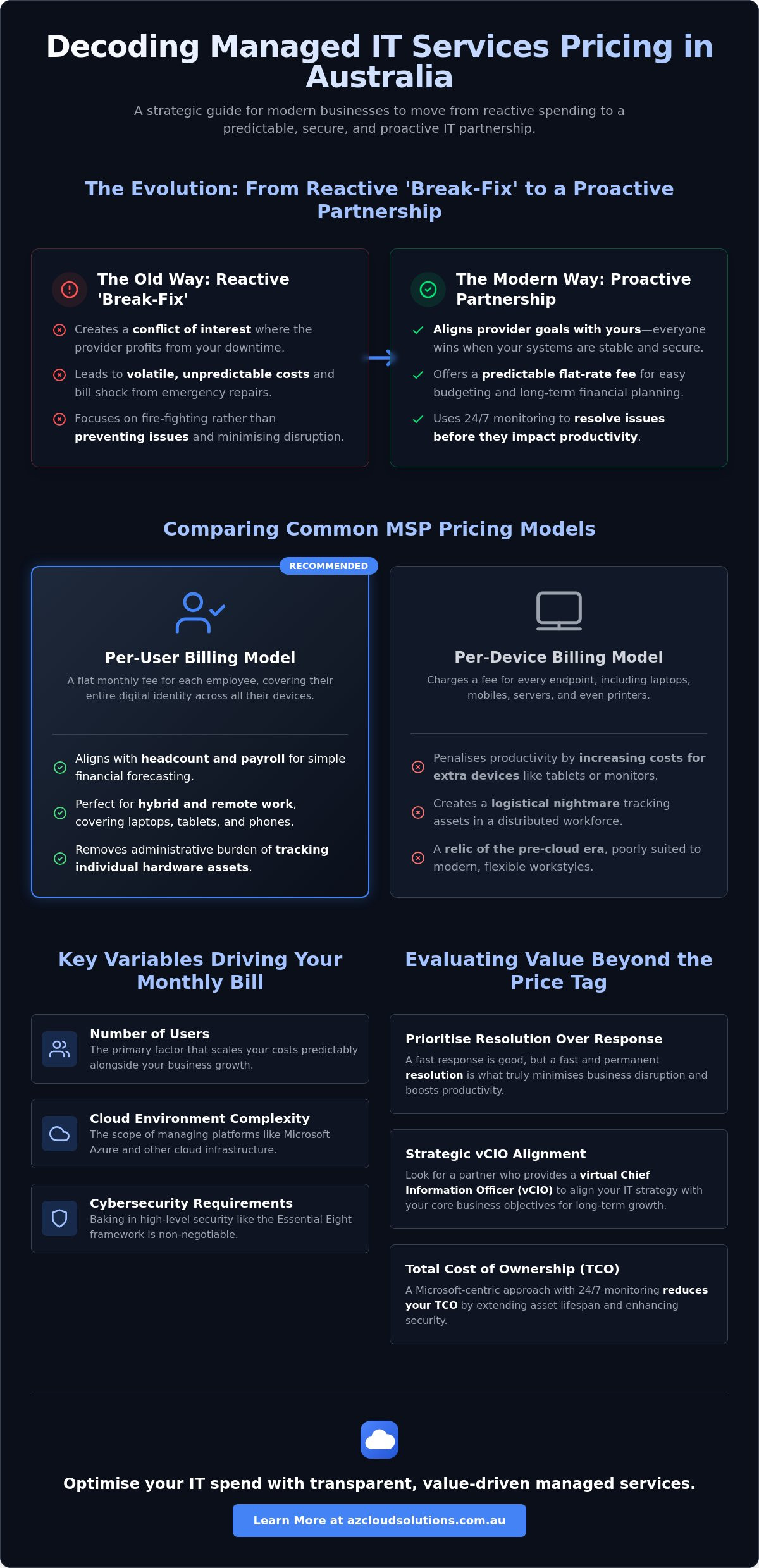
The Australian business environment in 2026 demands a shift in how technology is funded. With operational costs rising and economic pressures tightening margins, the old “break-fix” approach has become a significant liability. Historically, companies paid for IT support only when something failed. This created a fundamental conflict of interest where the provider profited from your downtime. Modern managed services pricing models australia organisations now utilise are built on a flat-rate partnership. This model aligns the provider’s goals with yours. If your systems are stable and your staff are productive, everyone wins.
A professional Managed service provider (MSP) uses this structure to offer budget predictability. Instead of facing volatile monthly invoices for emergency repairs, you pay a consistent fee that covers maintenance, security, and support. This investment is underpinned by a Service Level Agreement (SLA). The SLA isn’t just a technical document; it’s a commercial guarantee that justifies your monthly spend by defining the exact level of uptime and response you can expect. In the current climate, this certainty allows local executives to plan their capital expenditure with confidence.
The Evolution of IT Support: From Reactive to Proactive
Preventing a system failure is always cheaper than recovering from one. Proactive management uses 24/7 monitoring to identify and resolve hardware or software issues before they disrupt your staff. This approach reduces the total cost of ownership by extending the lifespan of your assets and minimising lost productivity. Additionally, many Australian insurers now require evidence of proactive management to qualify for lower cybersecurity insurance premiums. When you can prove your environment is patched and monitored, your risk profile drops. Your premiums often follow suit, creating a direct financial benefit from your IT strategy.
Why Pricing Transparency is the New Gold Standard
Hidden extras like “onboarding fees” or “after-hours surcharges” often plague traditional IT contracts. In 2026, transparency is the benchmark for a mature partnership. A fair Australian market rate for commercial-grade support should encompass the full management of your environment without unexpected spikes. This clarity allows you to allocate capital toward growth projects instead of emergency fire-fighting. Managed IT Services is a holistic business enablement tool that drives operational efficiency rather than acting as a mere technical expense. By removing the friction of unpredictable billing, you can focus on your core business objectives while your technical partner handles the heavy lifting.
Comparing the Most Common MSP Pricing Models for SMBs
Choosing the right structure is a critical step when evaluating managed service providers. In 2026, the per-user model has emerged as the dominant choice for Australian SMBs. This model charges a flat fee for each employee regardless of how many devices they use. It aligns perfectly with modern payroll cycles. It makes budgeting simple. If you hire a new staff member, you know exactly how your IT bill will change. Understanding the various managed services pricing models australia providers offer is vital for maintaining long-term financial health.
The Rise of the Per-User Billing Model
Hybrid work has made this model essential for local firms. An employee might use a laptop at the office, a tablet on the train, and a workstation at home. Per-user billing covers that individual’s entire digital identity. It removes the administrative burden of tracking hardware serial numbers or MAC addresses. This simplicity allows business owners to focus on headcount rather than inventory lists. It ensures that your IT costs scale predictably alongside your actual workforce growth.
Why Per-Device Pricing is Losing Favour
Per-device models charge for every single endpoint, including laptops, mobile phones, and even printers. While it seems precise, it often penalises productivity. If a staff member needs a second monitor or a tablet for field work, your costs spike. Tracking these assets in a distributed workforce is a logistical nightmare. Hardware-centric billing is a relic of the pre-cloud era where work was tied to a physical desk. It creates friction every time you want to upgrade your team’s toolkit.
All-You-Can-Eat (AYCE) models promise total coverage for a single monthly fee. These are popular because they eliminate bill shock for standard support requests. However, you must clarify where the boundaries lie. Most AYCE agreements exclude major projects or hardware refreshes. Tiered pricing provides a middle ground. It allows you to select a service level that matches your risk appetite. You might choose a basic tier for simple monitoring or upgrade to a premium tier for comprehensive endpoint management. This flexibility ensures you only pay for the specific protections your organisation requires to stay secure and operational.
Key Variables That Influence Your Monthly Managed Services Bill
While headcount is the primary driver in modern managed services pricing models australia providers use, the technical complexity of your environment plays a major role in the final figure. Two companies with 50 staff each will have different monthly costs if one operates on a legacy on-premise server and the other has completed an Azure cloud migration. Legacy systems often require more manual maintenance and carry higher hardware risks. Conversely, a mature cloud environment demands specialised management of identity and access but offers superior scalability and remote accessibility.
Support hours also create a significant pricing fork. A standard 9-to-5 helpdesk is sufficient for some, but a true 24/7 monitoring and response service is now the benchmark for organisations with distributed teams or high-security needs. If an alert triggers at 2:00 AM on a Saturday, a proactive partner is already remediating the threat before your team logs on Monday morning. Understanding these variables helps you decode why different managed services pricing models australia firms present vary so wildly in their initial quotes. It’s about matching the level of care to your specific operational risks.
The “Cybersecurity Tax”: Why Security Drives Pricing
In the current Australian landscape, the Essential Eight framework is the non-negotiable standard for risk mitigation. Implementing and managing tools like Microsoft Defender and Microsoft Entra requires constant vigilance. This isn’t a one-time setup. It involves ongoing compliance monitoring and policy adjustments to counter evolving threats. Cheap IT support often omits these layers, leaving your business vulnerable to ransomware. When you see a higher quote, it usually reflects the intensive labour required to keep your environment aligned with these national security benchmarks and insurance requirements.
Infrastructure Scale and Cloud Maturity
Cloud maturity also dictates the level of management required. Using Microsoft Intune for comprehensive endpoint management allows for automated security policies across all devices, but it requires expert configuration to be effective. Similarly, the cost of Business Continuity and Disaster Recovery (BCDR) depends on your recovery time objectives. Ensuring high availability for critical assets involves redundant backups and regular testing. While this adds to the monthly bill, it acts as an insurance policy against catastrophic data loss. Investing in a robust Azure environment and BCDR strategy ensures your business remains resilient regardless of technical failures.
How to Evaluate Value Beyond the Monthly Subscription Fee
A low monthly fee is meaningless if it results in high operational friction. When assessing managed services pricing models australia, looking at the sticker price is only the first step. You must evaluate the provider’s ability to drive your business forward. A reactive provider might respond to an email in ten minutes, but if it takes three days to fix a server, your productivity suffers. Resolution time is the metric that actually protects your bottom line. It measures how quickly your team can get back to work rather than just how fast a ticket was acknowledged.
A high-value partnership includes strategic alignment through Virtual CIO (vCIO) services. This ensures your technology roadmap supports your commercial goals. If you’re planning to expand into new markets or merge with another firm, your IT infrastructure must be ready before the first hire. Scalability is equally vital. Your pricing model should adapt to seasonal staff or rapid growth without requiring a complete contract renegotiation. A Microsoft-certified partner provides the specialised knowledge needed to ensure these transitions are seamless. They avoid the costly trial-and-error approach used by generalist providers, saving you money through efficient execution.
The Hidden Costs of Low-Cost Providers
Cheap providers often rely on “scope creep” to maintain their margins. They lure you in with a low base rate but charge extra for every minor configuration change or security update. This inflates your actual annual spend far beyond the original quote. There is also the “downtime cost” to consider. If a provider fails to respond effectively during a critical outage, the loss in staff productivity can dwarf the monthly service fee. Local Australian expertise is vital here. Managing national data privacy laws requires a partner who understands the domestic legal landscape and can provide on-the-ground support when it matters most. Using a provider without this local connection often leads to delays and regulatory oversights.
The Strategic Advantage of Managed Cloud
A proactive partner identifies ways to reduce your Microsoft 365 or Azure licensing costs by removing unused seats or consolidating services. They look for alignment between your software spend and your actual usage. Regular Technical Business Reviews (TBRs) should be a standard inclusion in your contract to ensure your environment remains optimised. These reviews allow for foresight and alignment, preventing technical debt from accumulating over time. A high-quality MSP acts as a disciplined extension of your leadership team by taking full ownership of technical outcomes. This allows you to focus on high-level strategy while your partner handles the heavy lifting. To see how a transparent partnership can secure your future, explore our managed IT services today.
Optimising Your IT Spend with Microsoft-Centric Managed Services
Efficiency in 2026 is found through consolidation. By leveraging the full Microsoft ecosystem, AZ Cloud Solutions eliminates the need for expensive third-party software that often duplicates existing features. Using Microsoft Defender for cybersecurity and Intune for endpoint management allows for a streamlined technical stack. This native integration reduces complexity. It also lowers the labour hours required for maintenance. When evaluating managed services pricing models australia businesses often overlook these hidden efficiencies. A Microsoft-centric approach ensures every dollar spent contributes directly to a more secure and unified environment.
A distributed Australian workforce requires a partner with national reach. Our 24/7 helpdesk ensures your staff receive support regardless of their time zone or location. Whether your team is in a Perth home office or a Sydney headquarters, the service quality remains consistent. This availability is a core component of our managed services, providing the stability needed for continuous operations. By centralising your support through a single, expert guardian, you remove the friction of managing multiple local contractors. This alignment between service delivery and business hours is essential for maintaining productivity across the country.
The AZ Cloud Solutions Approach to Pricing
Our commitment to transparency means your monthly fees are predictable. We provide a clear fee structure with no hidden surcharges or “bill shock” at the end of the month. This includes the management of Azure cloud environments and ongoing migration support. We integrate these services into a cohesive plan that covers proactive monitoring and backup solutions. This foresight ensures your data is protected and your systems are optimised without the need for reactive, high-cost emergency interventions. We take full ownership of your technical outcomes, allowing you to focus on your commercial objectives with total peace of mind.
Taking the Next Step Toward Predictable IT Costs
Transitioning from a legacy IT model to a managed Microsoft cloud environment is a structured process. We start by auditing your current infrastructure to identify redundancies and security gaps. This allows us to provide a tailored quote that reflects your specific business needs and headcount. Moving to a proactive model removes the uncertainty of technical failure and replaces it with a disciplined roadmap for growth. To begin this transition and secure your operations, you can organise a consultation with AZ Cloud Solutions to audit your current IT spend. Our team is ready to help you align your technology costs with your strategic objectives.
Securing Your Technical Future with Budget Certainty
Aligning your IT spend with your commercial goals is no longer a matter of guesswork. You’ve seen how the shift toward per-user billing simplifies growth and how prioritising resolution times over simple response metrics protects your bottom line. By selecting from the various managed services pricing models australia providers offer with a focus on Microsoft-native efficiencies, you remove the friction of unpredictable billing. This disciplined approach ensures your technology remains a high-performing asset rather than a liability.
As specialists in Managed Microsoft 365 and Azure, AZ Cloud Solutions provides the expert oversight required to maintain stability. Our 24/7 Australian-based helpdesk and monitoring services ensure your team stays productive; our focus on Essential Eight compliance mitigates your operational risk. We take full ownership of your environment so you can focus on leading your organisation with confidence. It’s time to move toward a partnership built on accountability and local expertise.
Get a transparent Managed Services quote for your Australian business and start your journey toward a more secure, streamlined future. We look forward to helping you achieve total technical peace of mind.
Frequently Asked Questions
What is the average cost of managed IT services for a small business in Australia?
Market rates for Australian small businesses vary based on user count, infrastructure complexity, and security requirements. Most managed services pricing models australia providers offer are structured as a monthly fee that scales with your headcount. This ensures you only pay for the support your team actually requires while maintaining a predictable operational budget.
Is it cheaper to have an in-house IT person or use a managed service provider?
Using a managed service provider is generally more cost-effective than hiring a full-time internal specialist. An in-house IT manager requires a salary, superannuation, and ongoing training. An MSP provides a full team of experts and 24/7 monitoring for a fraction of that total employment cost, giving you access to a broader range of technical skills.
What does “All-You-Can-Eat” IT support actually include?
This model typically covers unlimited remote and on-site helpdesk requests for your existing staff and systems. It includes proactive maintenance, security patching, and routine updates to keep your environment stable. It usually excludes major one-off projects, such as office relocations or the initial setup of a new Azure cloud environment.
How do managed services pricing models handle Microsoft 365 licensing?
Licensing is usually treated as a transparent pass-through cost or bundled into a comprehensive per-user fee. Most providers manage the onboarding and offboarding of users to ensure you aren’t paying for dormant seats. This keeps your software spend aligned with your actual payroll and ensures your security policies are applied to every new account.
Can I change my pricing model if my business grows or shrinks?
Yes, modern per-user pricing models are designed to be highly flexible. You can adjust your subscription monthly to reflect changes in your staff numbers. This agility is a key advantage of managed services, allowing you to scale up during peak periods or reduce costs if your team size decreases.
Does managed services pricing include the cost of new hardware?
Managed service fees focus on the labour, monitoring, and security management of your environment rather than the hardware itself. Computers, servers, and networking equipment remain capital expenses. Your partner will handle the procurement and setup of this hardware, ensuring it integrates seamlessly with your existing Microsoft-centric stack.
Why is per-user pricing better than per-device for hybrid teams?
Per-user pricing is superior because it follows the individual digital identity regardless of how many devices they use. A staff member might work from a laptop at the office and a tablet at home. Charging per device in this scenario would double your costs for a single employee, whereas per-user billing remains consistent.
How much extra should I expect to pay for 24/7 support?
Moving to a 24/7 support model typically involves upgrading to a higher service tier. This additional investment covers the specialised labour required for out-of-hours monitoring and emergency remediation. It provides a “safe pair of hands” to manage critical alerts while your local team is offline, preventing minor issues from becoming Monday morning disasters.