Most Australian business leaders view their IT contracts as defensive documents designed to protect the provider rather than the client. It’s a common frustration to feel like you’re paying for support while still fearing the hidden costs of downtime or getting lost in the confusing gap between a quick response and an actual resolution. To regain control of your technology, you need a service level agreement defined by clear business outcomes rather than technical jargon.
With Australian organisations forecast to spend over A$33.6 billion on public cloud services in 2026, the stakes for your digital infrastructure have never been higher. This guide will help you gain a clear understanding of what an SLA is and how it ensures your IT provider remains accountable for your business continuity. We will explore the framework required to measure IT performance effectively, ensuring your Microsoft 365 environment is actively monitored and that friction is eliminated from every support request. By aligning technical metrics with your commercial goals, you can transform a simple contract into a proactive roadmap for growth.
Key Takeaways
- Understand how a service level agreement defined for the modern landscape prioritises business continuity over basic technical metrics to protect your bottom line.
- Learn to distinguish between response and resolution times to ensure your IT support focuses on getting your team back to work quickly rather than just acknowledging a ticket.
- Discover how proactive 24/7 monitoring identifies and fixes vulnerabilities in your Microsoft 365 environment before they lead to costly, unplanned downtime.
- Gain a practical framework for holding your IT provider accountable through clear, measurable performance standards that align with your commercial goals.
- Understand why shifting from a reactive support model to a disciplined, managed approach reduces friction and provides a more stable foundation for business growth.
Defining the Service Level Agreement (SLA) in the Modern IT Landscape
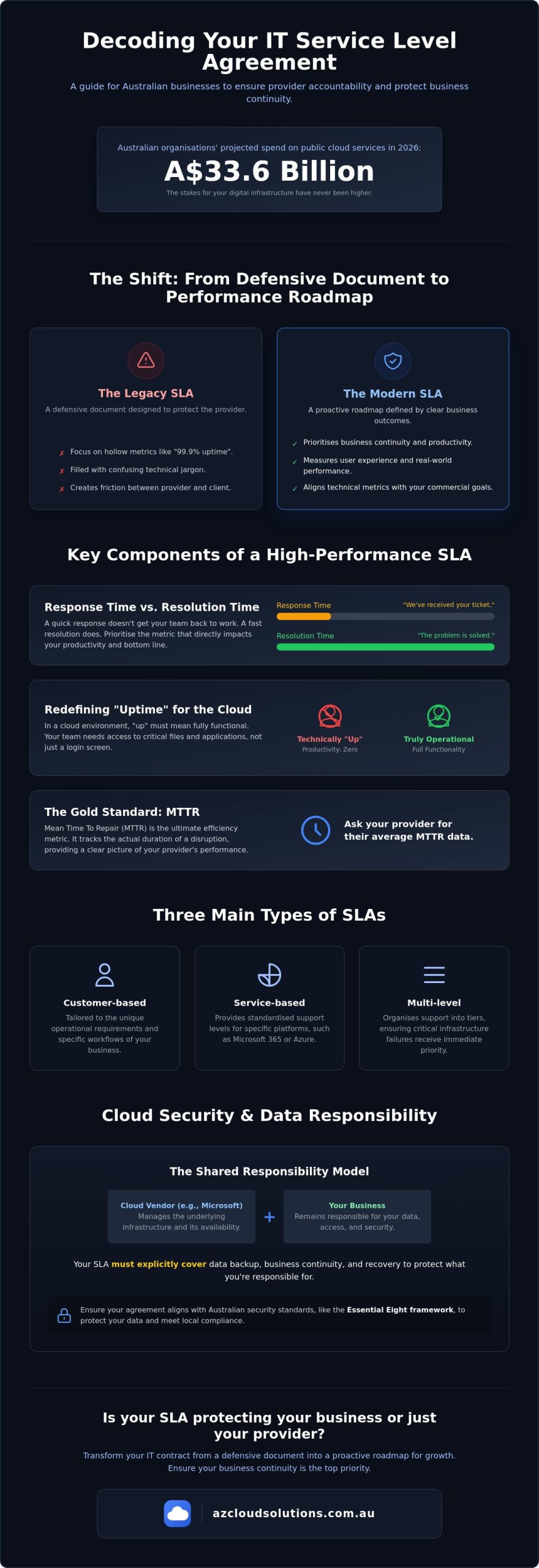
A Service-level agreement (SLA) is a formal commitment between a service provider and a business client. It outlines the specific expectations for service quality, availability, and responsibilities. However, having a service level agreement defined by legacy standards is no longer sufficient for modern Australian organisations. It needs to be more than a legal safety net; it must be a performance roadmap.
Historically, providers pointed to “99.9% uptime” as the ultimate success metric. In a cloud-native environment, this is often a hollow promise. If your team can log in to Microsoft 365 but can’t access critical files due to a sync error, the system is technically “up”, but your productivity is zero. We’re seeing a shift toward “experience-level” agreements. These focus on how technology actually serves the user. This approach ensures that IT acts as a foundation for accountability rather than a source of friction.
The Three Main Types of SLAs
Understanding how these agreements are structured helps you choose the right level of protection for your operations:
- Customer-based SLAs: These are tailored to the unique operational requirements and specific workflows of your business.
- Service-based SLAs: These provide standardised support levels for specific platforms, such as Azure cloud services or Managed Microsoft 365 environments.
- Multi-level SLAs: These organise support into tiers. They ensure that critical infrastructure failures receive immediate priority over minor software queries.
Why Cloud Computing Requires a Different Approach
The move to the cloud changes the rules of engagement. Under the shared responsibility models used by Microsoft Azure and Microsoft 365, the vendor manages the underlying infrastructure, but you remain responsible for your data and its security. A modern service level agreement defined for the cloud must go beyond simple connectivity. It needs to explicitly cover data backup and business continuity. If a provider doesn’t guarantee the integrity and recovery of your data, the agreement isn’t protecting your business; it’s simply protecting the provider’s uptime statistics.
Key Components of a High-Performance SLA for Australian Businesses
For an Australian business leader, the value of a contract isn’t found in its length, but in its clarity. When you look at a service level agreement defined for high performance, you must look past the initial sales pitch. A robust agreement provides a framework for accountability that protects your operations from both technical failure and commercial risk. It acts as a disciplined roadmap for how your technology should perform on a daily basis.
The key components of a high-performance SLA start with the distinction between response time and resolution time. A quick “we’ve received your ticket” email is a response, but it doesn’t restore your payroll system. You should prioritise resolution time. This metric directly impacts your team’s productivity and ensures your IT partner is incentivised to solve problems, not just acknowledge them. Clear performance benchmarks for system speed and cloud infrastructure responsiveness are equally vital to prevent “micro-downtime” from eroding your efficiency.
Uptime definitions must also be specific. With Australian organisations projected to spend over A$33.6 billion on cloud services in 2026, “working” must mean full functionality of your Azure and Microsoft 365 environments. Additionally, your SLA should align with the Essential Eight framework. This ensures your data management meets local security standards and helps you stay ahead of the ACCC’s 2026-27 focus on unfair contract terms and business protections.
Measuring What Matters
Mean Time to Repair (MTTR) is the gold standard for measuring efficiency. While first-response time provides peace of mind, MTTR tracks the actual duration of the disruption. If your current provider can’t provide clear data on their average repair times, it might be time to review your managed IT support options to ensure your business continuity is a priority. A service level agreement defined by these outcomes keeps your team focused on growth rather than troubleshooting.
The Role of Reporting and Accountability
Transparency is maintained through regular performance reviews. These sessions keep your managed service provider (MSP) proactive rather than reactive. A disciplined agreement includes clear escalation paths. When a critical server goes offline, you need to know exactly who is taking ownership and how quickly the issue will reach a senior specialist. This structure removes the friction often found in generic support contracts and ensures your IT environment remains a stable foundation for your business.
Beyond the Fine Print: How Proactive Management Delivers True Value
A service level agreement defined by modern standards is more than a list of penalties for when things go wrong. It’s a commitment to proactive management. When your IT provider acts as a “safe pair of hands”, they identify and resolve vulnerabilities before they ever trigger an SLA breach. This transition from reactive troubleshooting to vigilant oversight is what separates a standard vendor from a strategic partner that takes full ownership of your environment.
In a distributed work environment across Australia, 24/7 monitoring is essential for stability. Whether your team is collaborating in a metropolitan hub or working remotely in a regional area, their access to tools must be seamless. Integrating managed Microsoft 365 ensures that every endpoint and user is covered by your performance standards. This comprehensive approach transforms your SLA into a strategic tool for long-term planning and successful cloud migrations rather than just a document for dispute resolution.
Proactive Monitoring vs. Reactive Fixing
Legacy IT support relies on you reporting a problem after it has already caused a disruption. Modern managed services use automated alerts and endpoint management to stop issues in their tracks. By leveraging AIOps to predict system failures before they occur, your provider ensures your operations remain steady. This reduces the need for emergency calls and removes the friction that often plagues growing businesses. You gain the peace of mind that comes from a disciplined, automated approach to maintenance.
Choosing the Right Partner for Your SLA
Selecting a partner requires looking beyond the document itself to ensure they can actually meet the promises made on paper. You need to confirm they have the local Australian expertise to navigate national security requirements and compliance frameworks. A reliable partner will show you exactly how they meet their promises through transparent reporting and regular performance reviews. With Australian cloud spending set to grow by 17.9% in 2026, having a partner who understands local market conditions is vital for your continued growth and technical security.
Securing Your Business Continuity with Performance-Driven IT
A service level agreement defined for the modern Australian landscape is a powerful tool for accountability and growth. By shifting your focus from basic uptime to meaningful resolution times and proactive management, you ensure your technology serves your commercial goals rather than hindering them. This framework provides the transparency needed to turn a technical contract into a reliable roadmap for success. It allows you to move forward with the confidence that your systems are robust and your data is protected.
At AZ Cloud Solutions, we act as a disciplined, expert guardian for your environment. We provide 24/7 proactive monitoring and helpdesk support, backed by specialised Microsoft 365 and Azure expertise. Our approach removes the friction of IT management, allowing you to focus on your business while we handle the heavy lifting of cybersecurity and infrastructure optimisation. Discover how AZ Cloud Solutions secures your business with proactive managed IT. We’re ready to help you build a more stable and efficient digital future.
Frequently Asked Questions
What is the difference between an SLA and an SLO?
An SLA is the formal legal contract between you and your provider, while a Service Level Objective (SLO) is a specific target within that agreement. For example, your SLA might commit to high system availability, whereas the SLO defines that target as 99.9% uptime for your Azure environment. The SLO is the goal your provider aims for, and the SLA is the document that holds them accountable if they miss it.
Does an SLA guarantee that my IT will never break?
No agreement can prevent every possible technical failure; instead, an SLA defines the framework for response and resolution when issues arise. Even global platforms like Microsoft 365 experience occasional disruptions. Having your service level agreement defined by clear recovery protocols ensures that when a fault occurs, your provider has a disciplined plan to restore your operations quickly and minimise the impact on your bottom line.
What happens if a service provider fails to meet the SLA terms?
If a provider misses their performance targets, the agreement typically triggers service credits or financial penalties. These are usually applied as a percentage discount on your next monthly bill, providing a tangible form of compensation for the disruption. This structure ensures that your provider remains incentivised to maintain high standards and takes full ownership of their responsibilities as your technical guardian.
Is a 100% uptime SLA realistic for Australian small businesses?
Claiming 100% uptime is technically impossible and is generally considered a marketing gimmick rather than a professional standard. Most high-performing Australian organisations target “three nines” (99.9%) or “four nines” (99.99%) availability. A service level agreement defined by realistic expectations acknowledges that scheduled maintenance and rare outages occur, focusing instead on proactive monitoring and rapid repair to keep your business moving.